


TOP
TOP
TOP
TOP
TOP
TOP
TOP
TOP
TOP
TOP
TOP
TOP
TOP
TOP
SHOLL
June 19, 1886


Robert John Sholl, J.P., was 67-years-old when died in his son-in-law, Dr. Scott, M.L.C.'s home. He died on the evening of Saturday, June 19, 1886 and was buried in the Anglican Cemetery at East Perth the next day.
Dr. Scott was recently elected as the member for Perth and the funeral left his residence at 4 o'clock. It was attended by nearly all the leading men of Perth. The pall bearers were Sir Thomas Cockburn-Campbell, Bart., M.L.C., Mr. Mckenzie Grant, M.L.C., Dr. Waylen, and Mr. F. Lochee. The Very Rev. Dean Gegg met the cortege at the cemetery gate and conducted the service at the grave. He had also spoken of the deceased during the morning service in St. George's Cathedral.
Robert Sholl was born in England in 1819, the second son of Robert and Elizabeth (nee Mutton). He had been partially educated as a doctor before he arrived in Western Australia on November 18, 1840, aboard the Shepherd. His uncle, Richard Sholl, had been the purser on the Sulphur in the early days of the colony. His mother, sister Elizabeth (Mrs. Corbett), and brothers William and Charles, migrated with him. William was a surgeon and died many years earlier in South Australia. Charles was a long serving chief clerk in the Colonial Secretary's office.
Robert married Mary Ann Berkelman in Bunbury on September 21, 1844, and had eight children - Treverton Charles, Richard Adolphus, Robert Frederick, Horatio (Horace) William, Edward, Penelope Fanny, Arthur, and Charles Edwin.
He worked for many years as a clerk to the Bench, as a tidewaiter and as a schoolmaster at Bunbury, under Mr. Eliot. In 1855 he edited the Commercial News which later amalgamated with the Inquirer newspaper. He began the Herald in Fremantle and later returned to edit and part own the Inquirer.
In the early 1864, Governor Hampton chose him to establish a settlement at Camden Island in North-Western Australia when men from the Eastern colonies were setting out in search of the "Denison Plains." They had been publicised in the reports of Augustus Gregory and were said to exist on or near the Victoria River.
The Government expedition left for Camden Sound with Robert Sholl at its head. His surveyor was James Cowle, his surgeon was Charles Smith Bompas, and his private secretary was his son Trevarton. Some Pensioner Guards and labourers accompanied them.
After the Denison Plains Company disbanded, the Government party stayed on until it was recalled. It was based at Nicholl Bay. Robert Sholl was appointed Government Resident and he oversaw the development of that part of the territory. He was virtually a Lieutenant-Governor as in those days the only communication with the settled districts in the south was by sailing vessels, which was both infrequent and tedious.
Pearl shells and pearls were exported from the area and the surrounding land was occupied by squatters. Sheep, cattle, and horses, soon made many of them into wealthy men. Messrs. Grant, Harper, and Anderson settled on the DeGrey River, exploration was extended, the population increased, and Robert Scholl was responsible for the district's order and social well-being.
His many duties included that of Magistrate, collector of Customs, Lay Reader, Surgeon and Sunday-school teacher, and although he was at the disposal of the public, the public treasury did not reward him. After a hurricane blew down his house, destroyed his "household stuff" and broke his son's thigh, Robert built a hovel out of the wreckage and continued his public duties.
The Government never reimbursed his considerable losses, among which were his irreplaceable books. Even though his rule and guidance had brought new wealth to the Government, his meagre £500-a-year salary was never increased.
Eventually, he accepted a pension during the first administration of Governor Robinson,
retired from public service, and lived in Perth until he died.

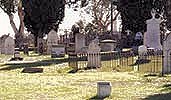
| Fowler 1898: Sholl 1886-1896: Site 5.5m x 7.3m, six interments. Two headstones A & B and a small gravesite C. A (North): Vertical white marble pedestal/obelisk with top panel containing inclined Latin cross encircled by wreath and floral decor. Lead lettering, condition good. | 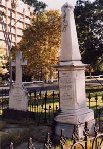 |
B (South): Vertical white marble calvary cross with fluted and stepped shoulders/base. Lead lettering, conndition good.
C (East): A small area enclosed by white marble edging. Possibly child's grave? No bio-data.
Mason: Morgan Sanders, Perth.
Surround: Cement/brick kerb surmounted by two-tier iron paling fence. Concrete top to tomb.
[East Perth Cemetery: Resting Place of Western Australian Pioneers,
J.Richardson & D.Davies, 1986, vol.3, pp.114-5]

| A (North) East face: Sacred to the memory of Robert John Sholl, died 19th
June 1886 aged 67 years.
Was Government Resident of the North District from its first settlement in the year 1865 to the year 1891. Also Mary Ann, wife of above, died 16th July 1889 aged 67 years. "Blessed are they that fear the Lord and walk in his ways" PS CXXVIII. A (North) North face: Also Arthur Sholl sixth son of R.J. & Mary Ann Sholl, died 8th December 1894 aged 36 years. | 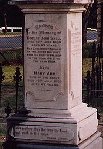 |
| A (North) South face: Also Trevarton Charles, their eldest son who was lost
at sea in the Schooner Emma whilst on a voyage from Cossack to Fremantle in March 1867
aged 22 years.
Also Evelyn Mary eldest child of Edward and Fanny Sholl. Died 13th September 1891 aged 4years and 9 months. | 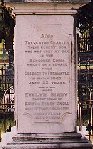 |

